Trackballs serve as core precision human-machine interaction components widely deployed in industrial control consoles, medical ultrasound (USG) systems, ship dispatching terminals, surveillance workstations and high-precision medical devices.
Two mainstream industrial & medical-grade trackball solutions dominate the market: mechanical trackballs and optical trackballs. Many equipment engineers, procurement specialists and maintenance technicians frequently confuse their core differences, leading to improper part selection, cursor lag, frequent breakdowns and mismatched operation feel.
As a professional trackball manufacturer, Zhuhai Xinhe Electric Co., Ltd. compiles this objective, data-backed technical guide based on global industrial component standards, mainstream equipment parameters and real-world medical USG application data to help buyers make accurate purchasing decisions.
Traditional ultrasound B-ultrasound & color Doppler machines mostly adopt mechanical trackballs, while newly launched premium medical equipment has fully upgraded to optical trackball solutions.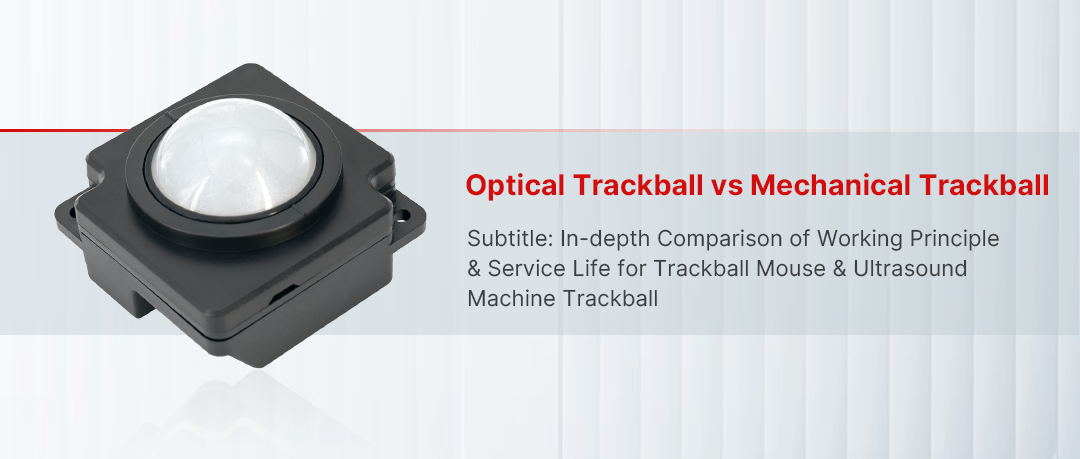
A mature traditional solution with decades of technical iteration, mechanical trackballs relies on physical contact friction to output movement signals. Its assembly includes rolling sphere, X/Y dual-direction friction rollers, transmission shafts, grating encoder discs and infrared transmitter-receiver sensors.
Working Flow:
This proven, highly compatible design was the standard configuration for legacy USG ultrasound trackballs and classic industrial trackball mice.
The next-generation upgraded solution eliminates all rollers, transmission shafts and friction transmission parts, adopting pure non-contact optical sensing technology.
Working Flow:
Thanks to wear-free performance and outstanding stability, optical trackballs are now standard for premium medical equipment, marine & military systems, and industrial terminals running non-stop around the clock.
All parameters extracted from publicly released industrial human-machine component technical datasheets: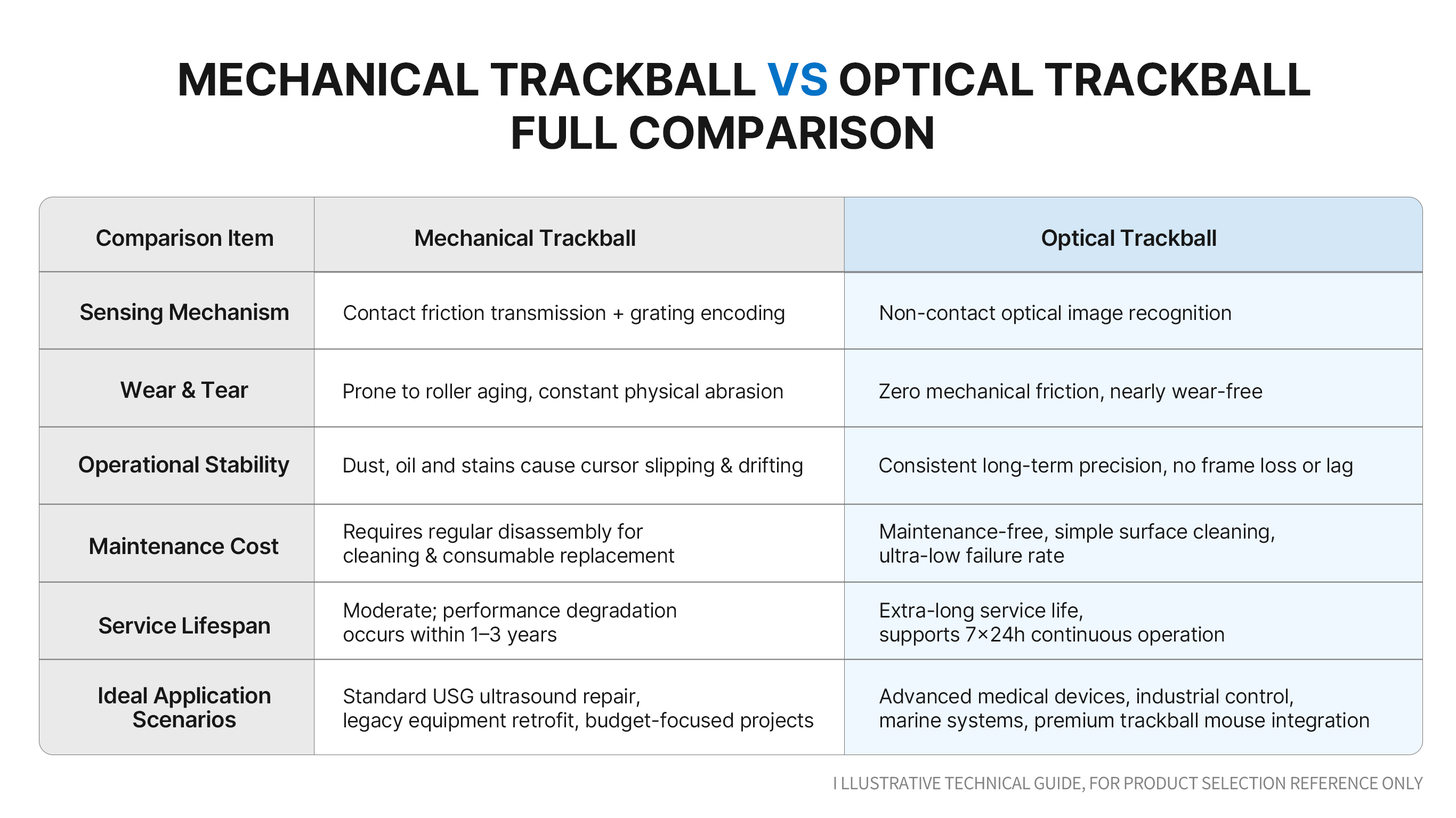
Physical friction components accumulate skin oil, workshop dust and ultrasound coupling gel over long-term use, resulting in stuttering, slow response and unresponsive cursor movement. Regular disassembly cleaning is mandatory, and rubber rollers are consumable parts requiring periodic replacement.
Higher overall cost of optical sensor modules compared with mechanical alternatives; minor adaptability issues may occur with ultra-smooth highly reflective ball surfaces, requiring a short adaptation period for users unfamiliar with damping-free operation.
For 7×24h non-stop operation, dusty/oily harsh environments and strict stability requirements: Optical trackballs are the top choice.
For existing console upgrades, simple control station assembly and cost priority: Mechanical trackballs deliver optimal value.
For graphic design, precision manipulation and long-hour office use: Optical trackballs provide durable, maintenance-free high accuracy.
According to international human-machine interface component industry research, optical trackballs have seen steady year-on-year market share growth and become the standard configuration for high-end industrial and medical devices.
Mechanical trackballs remain relevant rather than obsolete. Their broad compatibility, low cost and classic tactile feedback maintain steady demand for legacy equipment repair and aftermarket replacement, forming a long-term complementary market with optical trackballs.
Zhuhai Xinhe Electric Co., Ltd. is a professional trackball manufacturer customizing industrial & medical-grade mechanical trackballs, optical trackballs and dedicated USG ultrasound trackball modules. We support customized sizes, multiple interfaces (USB / RS232 etc.), varied IP waterproof ratings and embedded mounting solutions, widely applicable to ultrasound medical systems, industrial control terminals, marine onboard equipment and dispatch monitoring stations.
Trackball mouse and USG ultrasound trackball selection does not require blindly opting for the latest optical model:
Contact Zhuhai Xinhe Electric Co., Ltd. to obtain trackball datasheets, free sample testing, customized design solutions and bulk wholesale quotations. We provide one-on-one professional technical selection support for global buyers!

